



Quick Answer: No firm holds a verified title as the largest commercial concrete contractor in Houston. Rankings shift by revenue, crew count, and yardage placed, and none of it is audited. What matters on your job is placement capacity on your pour date: available crews, batch plant throughput, haul time to the site, and mix design approval history.
Search that phrase and you get directory listings, paid placements, and self-reported claims. Texas does not license concrete contractors at the state level, and no public registry tracks cubic yards placed by firm. The Houston metro supports several hundred outfits calling themselves commercial concrete contractors, ranging from three-truck flatwork crews to divisions of national builders. Nobody is checking the math on who is biggest.
The question behind the search is usually not about size at all. It is about whether a contractor can absorb your scope without dropping it: a 180,000 square foot tilt-wall distribution slab in Baytown, a six-level parking structure in the Texas Medical Center, a detention basin for a Fort Bend County municipal utility district. Size is a rough proxy for that ability. It is a poor one, and betting a schedule on it is how general contractors end up grinding floors that were supposed to be finished.
Why This Matters
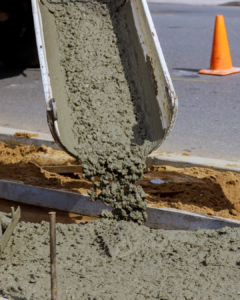 On most commercial ground-up projects, the concrete package is the single largest trade cost, and it sits squarely on the critical path. When the slab slips, the steel erector slips, the roofer slips, MEP rough-in slips, and the flooring subcontractor slips. On a school bond package or a Class A office shell, liquidated damages start accruing against a delay nobody can recover through overtime, because concrete cures on its own schedule.
- Concrete is the trade least tolerant of a bad day. A framing error gets adjusted. A failed 12,000 square foot placement gets demolished, hauled off, and paid for twice.
- Failed breaks escalate fast. Cylinders below the specified strength at 28 days trigger core drilling under ASTM C42, engineer review, sometimes load testing, and occasionally structural remediation that reopens the design.
- Public work carries paperwork that small crews cannot staff. Payment and performance bonds, certified payroll, retainage, and documented quality control require back-office capacity, not just field capacity.
- Rework has no float. Once the slab is the constraint, every downstream trade is idle and billing for standby.
How Concrete Capacity Actually Gets Measured
Capacity is not headcount. It is the ability to run your placement at full rate on the day you need it. Four things determine that, and only one of them shows up on a company profile page.
Crew depth and simultaneous placements
A firm with 200 field employees is not the same as a firm that can run four independent placement crews on the same Tuesday. Ask how many superintendents they carry, how many laser screed operators, how many certified finishers per crew, and specifically what else they have in the ground during your pour window. A large contractor stretched across five active jobs staffs your pour with whoever is left over.
Batch plant throughput and truck cycle
This is the constraint most estimators underweight. A placement crew moves only as fast as the trucks feeding it. A 700 cubic yard mat foundation placed by boom pump at 90 to 110 yards per hour needs a loaded truck arriving every four to six minutes, sustained, for seven straight hours. That requires a plant with the batching rate and drum count to hold the cycle, plus a return leg that does not strand trucks in traffic. Understanding how ready mix concrete is batched and delivered is what separates a realistic pour plan from an optimistic one.
Haul time and the ASTM C94 clock
ASTM C94 caps discharge at 90 minutes or 300 drum revolutions from the introduction of mixing water, whichever comes first. Houston traffic spends that budget quickly. A plant 12 miles out is 22 minutes at 6 a.m. and 55 minutes on the 610 loop at 3 p.m. Contractors sourcing from a single distant plant lose loads to rejection and pay for it in cold joints, which become the crack pattern the owner notices in year two.
Mix design bench and submittal history
ACI 318 allows a mix to be qualified through historical strength records or a trial batch program. A supplier with years of documented 4,000 and 5,000 psi Houston placements on file, complete with standard deviation data, clears an engineer’s submittal in days. A supplier without that record runs trial batches and waits out a 28 day cycle before anyone breaks ground.
Common Mistakes and Risks
These are the failure patterns that show up repeatedly on Houston commercial jobs, and what each one costs.
- Treating a directory ranking as vetting. Most “top contractor” pages are pay to list. They confirm a marketing budget, not bonding capacity or an experience modification rate.
- Awarding on crew size while ignoring the supply side. A large contractor locked into one plant with no secondary source has a single point of failure. Plant breakdowns, aggregate shortages, and cement allocation during peak season are all real in this market.
- Never naming the plant in writing. Suppliers dispatch from whichever facility has capacity that morning. On a critical placement, the originating plant and the assigned truck count belong in the purchase order.
- Improvising hot weather protocol. From May through September, Houston is ACI 305 territory. Concrete placed above 95 degrees Fahrenheit loses slump quickly, sets early, and develops plastic shrinkage cracking before the finishers clear the slab. Chilled batch water, ice substitution, retarder dosage, evaporation retardant, and night placements are planned in the preconstruction meeting, not decided at 11 a.m. on pour day.
- Allowing water at the truck. Retempering beyond the design water allowance is the most common cause of low breaks, surface dusting, and crazing. Every added gallon raises the water to cement ratio and lowers strength, and the ticket rarely records it.
- Assuming size equals coverage. Verify general liability limits, additional insured endorsements, and waiver of subrogation against your actual contract language rather than against the firm’s reputation.
- Skipping the preconstruction conference. ACI 301 calls for one on the concrete package. It is where the finish schedule, joint layout, curing method, and testing agency responsibilities get settled before anyone is standing in wet concrete arguing about them.
National Builder, Regional Specialist, or Self-Perform
Commercial concrete reaches the ground three ways in this market, and each fits a different risk profile.
The national or multi-state contractor
Use when: the project is a multi-phase industrial campus, requires single-source responsibility across several states, or carries bonding requirements above 50 million dollars.
Avoid when: your job is a single 60,000 square foot slab. You become the smallest project in the branch office and get staffed accordingly.
The Houston regional specialist
Use when: the work is local, the schedule is tight, and you need a superintendent who knows Harris County inspection rhythms, Gulf Coast subgrade behavior, and which streets will not take a boom pump.
Avoid when: the bonding requirement exceeds their surety capacity, or the scope demands specialized post-tensioning or architectural work they subcontract anyway.
General contractor self-perform
Use when: the GC carries a genuine concrete division with dedicated equipment and finishers on payroll, not a superintendent borrowing a crew.
Avoid when: self-perform means the GC bought the low bid on labor and is managing the placement personally. Coordination savings evaporate the first time a finisher walks off.
Across all three, the supply relationship is what determines whether the plan survives contact with the schedule. A contractor of any size working with a commercial concrete supplier with real dispatch depth outperforms a larger firm that cannot get trucks to the pour.
What Happens When Size Is the Only Filter
A recognizable pattern: an industrial developer in northeast Harris County awards a 220,000 square foot warehouse slab to the largest bidder on the list. The firm is genuinely large. It also has three jobs running in Fort Bend that month, so your placement gets a borrowed crew and a subcontracted finishing team. Floor flatness comes back at FF 22 against a specified FF 35. The racking installer cannot set posts to tolerance, grinding gets added to the scope, and the tenant improvement schedule loses three weeks. The size was real. The attention was somewhere else.
Why Choose TEXAN Concrete Ready Mix
Experience
TEXAN Concrete Ready Mix maintains a staff of certified concrete technicians who build customized mix designs rather than pulling a generic 3,000 psi ticket off a shelf. That matters on Houston jobs where sulfate exposure, expansive clay subgrade, and high summer placement temperatures all pull the mix in different directions at once. The available concrete products and mix options cover everything from standard structural mixes to designs built around a specific engineer’s spec.
Reliability
The company operates from two plants, 6001 Homestead Road in Houston and 21990 FM 1314 in Porter. Two batching locations means a second source when one plant is running at capacity, and shorter haul legs to opposite ends of the metro. The stated mission is unglamorous and exactly right for this trade: deliver quality concrete on time.
Quality and Technology
A fleet of more than 25 mixers running GPS tracking gives dispatch live visibility into truck position and cycle time, which is what allows a superintendent to hold a continuous placement instead of guessing when the next load lands. Quality control is applied at the plant, before the material is on your slab and impossible to correct. Contractors estimating quantities before a bid can run numbers through the concrete volume calculator to size orders accurately.
Service Area and Coverage
Coverage runs across the greater Houston metropolitan area, with dedicated service into The Woodlands and Spring and north into Conroe. For contractors working the northern growth corridor along I-45 and US 59, the Porter plant materially shortens the haul and keeps loads well inside the C94 window.
Frequently Asked Questions
Is there an official ranking of the largest commercial concrete contractor in Houston?
No. Engineering News-Record publishes national and regional contractor rankings by revenue, but those are self-reported and cover all construction types, not concrete placement volume specifically. No Texas agency tracks yardage placed by firm. Any local ranking you find is either a paid directory or an editorial guess.
How much concrete can a single crew place in one day?
For commercial slab on grade with a laser screed, a well-equipped crew typically places 400 to 900 cubic yards in a shift depending on pump versus direct chute access, slab thickness, and finish requirements. Superflat floors with tight F-number tolerances run substantially slower because the finishing sequence controls the pace, not the placement.
What insurance and bonding should a commercial concrete contractor carry?
Expect general liability at minimum one million per occurrence with a two million aggregate, auto liability, workers compensation meeting Texas requirements, and umbrella coverage sized to the project. On public work, payment and performance bonds are required under the Texas Government Code for most contracts above the statutory threshold. Ask for the experience modification rate as well, since anything above 1.0 signals a claims history.
Does the supplier or the contractor own a strength failure?
It depends on what the cylinders and the delivery tickets show. If the batch left the plant on design and the ticket records no added water, the investigation moves to field handling: retempering, improper consolidation, curing, or cylinder casting technique under ASTM C31. This is exactly why ticket discipline and third party testing coordination are settled before the first placement rather than after a failed break.
How far in advance should a large commercial pour be scheduled?
For placements above 500 cubic yards, give the supplier at least a week so dispatch can reserve drums and stage the truck rotation. During peak season, and especially for night pours scheduled around summer heat, two weeks is better. Same-week requests for high-volume continuous placements are where schedules break.
Getting a Real Answer for Your Project
Rather than chasing a title nobody can verify, define the constraint. Establish your yardage, your placement rate, your finish tolerance, and your pour window, then evaluate contractors and suppliers against those numbers. A firm that can articulate exactly how many trucks it will stage and which plant they leave from has told you more than a ranking ever will. To confirm supply capacity and mix availability for an upcoming commercial placement, request a quote from TEXAN Concrete Ready Mix or call 713-255-3333.